
IEEE/IEIE ICCE-ASIA 2026
October 28(Wed) – 30(Fri), 2026 / SAINT JOHN’S Hotel, Gangwon-do, South Korea
Program


TODAY 2026. 09. 30
ICCE-ASIA 2026
D-28
Plenary Talk
From Tokens to Topology: System-Level LLM Optimization for Latency, Throughput, and Cost in Production Workflows
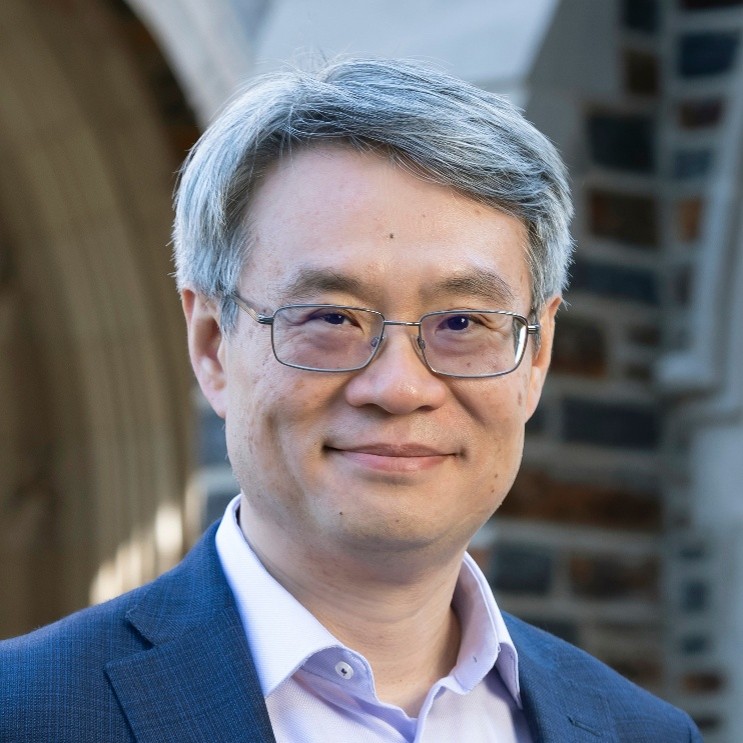
Prof. Yiran Chen
Duke University
Abstract
As large language models (LLMs) are increasingly deployed in real-world applications, their practical performance depends not only on model capability but also on the efficiency of the supporting systems. This talk presents a system-level view of LLM optimization, focusing on training-free, plug-and-play strategies to address challenges such as long-context processing, KV-cache traffic, redundant computation in multi-agent pipelines, and workflow-level latency. Through examples spanning long-context inference, multi-agent collaboration, and non-autoregressive generation, it will show how coordinating computation, memory, and execution can improve time-to-first-token, latency, throughput, and GPU utilization without sacrificing quality, offering practical insights into scaling LLM systems for production workloads.
Bio
Yiran Chen is the John Cocke Distinguished Professor of Electrical and Computer Engineering at Duke University. He serves as Principal Investigator and Director of the NSF AI Institute for Edge Computing Leveraging Next Generation Networks (Athena), Director of the Institute for AI Engineering (IAIE), and Co-Director of the Duke Center for Computational Evolutionary Intelligence (DCEI). His research spans emerging memory and storage technologies, machine learning systems, neuromorphic computing, and edge AI. He has authored more than 700 publications and holds 96 U.S. patents. His research has been recognized with three Test-of-Time Awards and 15 Best Paper and Best Poster Awards. He is a recipient of the IEEE Circuits and Systems Society Charles A. Desoer Technical Achievement Award, the IEEE Computer Society Edward J. McCluskey Technical Achievement Award, and the IEEE Council on Electronic Design Automation A. Richard Newton Technical Impact Award. Chen is the founding Editor-in-Chief of the IEEE Transactions on Circuits and Systems for Artificial Intelligence (TCASAI) and the founding Chair of the IEEE Circuits and Systems Society’s Machine Learning Circuits and Systems (MLCAS) Technical Committee. He is a Fellow of the AAAS, ACM, IEEE, and NAI, and a member of the European Academy of Sciences and Arts.
Will the Age of Humanoids Come? The Age of Robots Will.
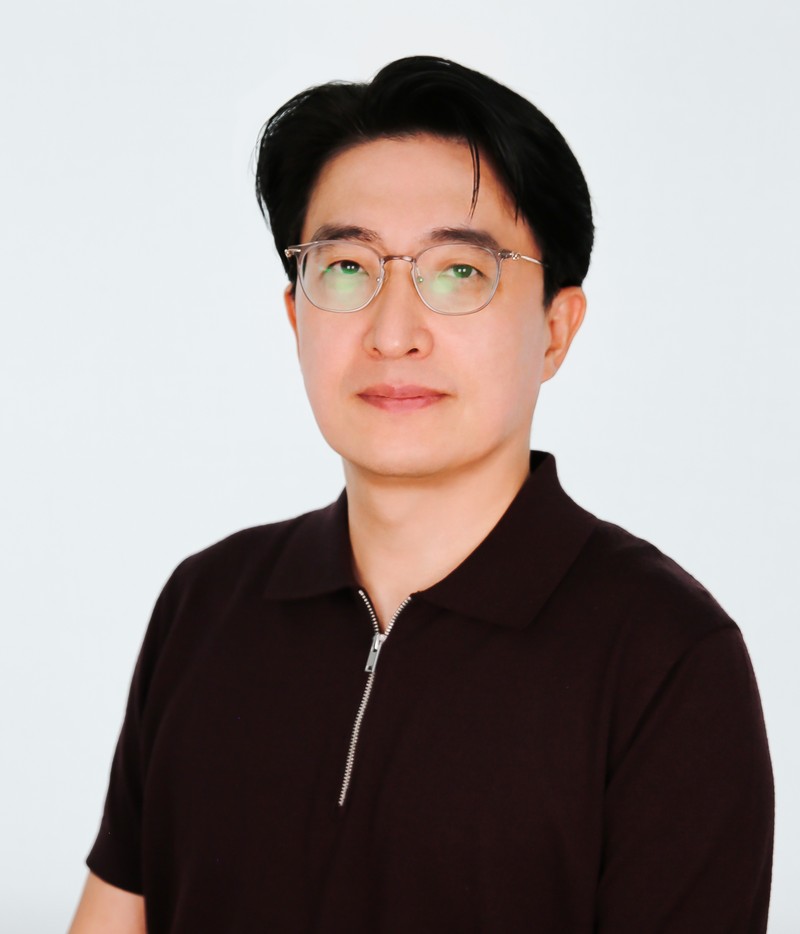
Dr. Youngjae Kim
Senior Research Fellow (VP), LG Electronics Inc.
Abstract
There is growing excitement—and skepticism—about the future of humanoid robots. Will humanoids really become part of our everyday lives and transform industries, or are we expecting too much from a technology that still faces enormous challenges in capability, reliability, safety, and economics?
Having spent years developing robots, I have to admit that I don’t have a clear answer. But there is one thing I am increasingly convinced of: the age of robots is inevitable.
Demographic change, labor shortages, automation, and the rapid advancement of AI are creating a world in which robots will become less of an option and more of a necessity. At the same time, AI is fundamentally changing what robots can do—enabling them to perceive, understand, reason, and act in ways that were previously difficult to imagine.
So perhaps the more important question is not whether humanoids will succeed, but what form the robot revolution will ultimately take.
In this keynote, I will share perspectives from the real-world experience of developing robots—from the gap between technology and expectations to the challenges of turning research into reliable products. I will explore why we should remain skeptical about the humanoid hype while remaining confident about the coming age of robotics.
Bio
Dr. Kim received his B.S. from Seoul National University in 1999 and his M.S. and Ph.D. from Stanford University in 2003 and 2007, all in Electrical Engineering.
He is currently working for LG Electronics Inc. as a senior research fellow (VP). Previously, he worked as a Communication Systems Engineer in Qualcomm Inc and Apple Inc. and as a Vision and Robotics Engineer in Velodyne LiDAR Inc. His research interest focuses on signal processing and robot SW but he is generally interested in all sorts of engineering problems that may be solved in a systematic fashion.
In 2025, he authored a book “AI+Robot”, which has been selected as Sejong Book by the Korean government.
